ARTE : ZHIWEI TU
.jpg) |
| ARTE ZHIWEI TU |
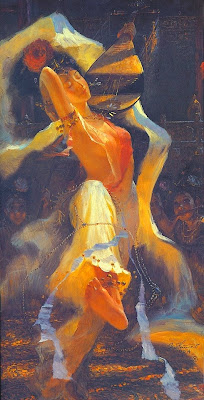
Awards winning painter Zhiwei Tu was born in Northern Guangdong Province, China.
Pocos artistas pueden afirmar el privilegio de contar con un museo de arte en su reconocimiento en vida: el Museo de Arte Tu Zhiwei de Shaoguan. ¿Cuán notable es que Tu Zhiwei haya alcanzado este logro partiendo de inicios humildes? Su existencia y su labor como artista son un testimonio de auténtico talento, valentía, perseverancia, esfuerzo y una generosidad notable.
Nacido en un empobrecido pueblo montañés en el condado de Wengyuan, en la provincia de Guangdong, Tu proviene de una región donde persisten muchas de las viejas historias y leyendas entre sus habitantes, a diferencia de quienes residen en áreas urbanas. Esto puede ser uno de los motivos por los cuales, al final de su carrera, Tu Zhiwei se ha sentido atraído por eventos históricos. En su arte, el pintor busca plasmar la sinceridad, la ingenuidad y la esencia primitiva presentes en las personas de estas comunidades aisladas, lo que se refleja en sus representaciones, tanto en sus cuadros históricos como en sus retratos de tibetanos.
Tu se formó en el Instituto de Bellas Artes de Guangzhou y trabajó durante siete años como profesor asistente de arte en la misma institución. Algunos docentes de alto nivel habían visitado varios países para explorar el arte occidental de los siglos XIX y XX, como el Realismo y el Impresionismo francés. Bajo su enseñanza, Tu desarrolló una base sólida tanto en su técnica como en el manejo del color.
En 1987, llegó a Estados Unidos para avanzar en estudios sobre la pintura al óleo y obtuvo un segundo título de MFA en la Universidad de Drake en 1990. Allí, recibió un gran estímulo e inspiración de su mentor, el Profesor Jules Kirschenbaum. Mientras profundizaba en el arte contemporáneo americano, Tu comenzó a definir su propio estilo. Su trabajo ha sido expuesto en numerosas ocasiones y ha obtenido diversos premios, entre ellos tres medallas de oro y una de plata.
Zhiwei Tu (Romantic
Impressionist Painter) was born in Northern Guangdong Province, China.
As a child he worked his family’s land, herded sheep, and attended the
village school. It was there that he became infatuated with painting and
drawing. When he was in high school, a professional artist was sent to
the village to paint a portrait of Mao Zedong.
For seven hours straight, Tu watched the artist work, and afterwards, he
bought his own paints and painted his own portrait of Mao. When he
showed it to the village officials a few days later, they decided to
display his piece as it was far more impressive than the commissioned
piece. By 1975 he had earned a BA from the Guangzhou Institute of Fine
Arts in Canton, and became a teacher of art at the Teaching College of
Shiao Gaun, China.
The Cultural Revolution in China forced the closing of all graduate
programs until 1978, when the movement lost its energy. During the
interruption of his studies, Tu traveled extensively throughout China
studying Chinese history and culture, and producing hundreds of
paintings. Later, these served as great sources of information and
inspiration for much of his work.
Finally, in 1978, Tu entered a compitition for admission to the
Gaungzhou Institute, won, and entered to earn his master’s degree.
Staying there only three years, he moved on the become Professor of Fine
Art at the Guangzhou Institute, and while teaching he earned his MFA in
1981. In 1987, Tu entered Drake University in Des Moines, Iowa, to
study both Art and English full-time.
During those three years, he drove all over the midwest and east coast
to over twenty invitational shows in Minneapolis, Chicago, and Kansas.
Ever since then, Tu has had numerous one-man shows all over the United
States and throughout the Orient.
More
—
Tu Zhiwei was born in 1951 on the banks of the beautiful Weng River –
Liuli Longchuan Village, Wengyuan County, Shaoguan, Guangdong Province.
Tu Zhiwei has been diligent and eager to learn since childhood. He loves
painting and painting. He has been fascinated by paintings and fainted
in the studio. From 1970 to 1972, he worked as an art teacher at the
County Cultural Center. From 1975 to 1978, he worked as a teacher at
ShaoguanNormal School. In 1975, he graduated from the Guangzhou Academy
of Fine Arts.
In 1981, he graduated from the GraduateSchool of the Oil Painting
Department of the Guangzhou Academy of Fine Artsand obtained a Master of
Arts degree. He joined the Chinese Artists Association in 1985 and went
to the United States to study in 1987. He obtained a master’s degree in
fine arts and later settled in the United States.
Tu Zhiwei was included in the “Chinese Modern Artists Celebrity
Dictionary” in 1992. Tu Zhiwei joined the National Oil Painters
Association in 1993. He was awarded the Special Prize of the President
of the Association in 1996 and was awarded the honorary membership of
the Association in 1997. In 1998, he won the gold medal of the annual
meeting of the Association. In 1999, he became a master member. From
2000 to now, he served as executive director and director of the art
judges.
In 2002, he was awarded the grand prize of the masters of the 11th
annual exhibition of the association. In the same year, he was elected
as the vice chairman of the association. In 2004, he was elected as the
chairman of the National Oil Painters Association. This is the first
time in the history of the organization to be chaired by Chinese. . View
more at: https://wooarts.com/zhiwei-tu/
.jpg) |
| ARTE ZHIWEI TU |
.jpg) |
| ARTE ZHIWEI TU |
.jpg) |
| ARTE ZHIWEI TU |
.jpg) |
| ARTE ZHIWEI TU |
.jpg) |
| ARTE ZHIWEI TU |
.jpg) |
| ARTE ZHIWEI TU |
.jpg) |
| ARTE ZHIWEI TU |
ENTRADAS DESTACADAS
BALADA DE CHANG’AN POR LI BAI BALADA DE CHANG’AN Cuando mis cabellos comenzaron a cubrir mi frente Delante de la puerta me divertía recogien...

-
FRASES BONITAS ,PENSAMIENTOS Y CITAS ILUSTRADAS PARA COMPARTIR. El hombre razonable se adapta al mundo : el irracional persiste en tratar...
-
LA ORACIÓN GESTALT DE FRITZ PERLS La Oración Gestalt “Yo soy yo y tú eres t ú Yo no estoy en este mundo para cumplir tus exp...
-
PENSAMIENTOS -FRASES CÉLEBRES, REFRANES, CITAS, POEMAS Y OTRAS CURIOSIDADES ILUSTRADAS La respuesta más sana a la vida es la alegría. De...
-
OFICIO POR MARCO MARTOS Para el peruano Marco Martos (1942), el poeta es “un hombre poseído por el espíritu de la lengua ” y la poes...
-
CARL ROGERS CITAS Y FRASES CARL ROGERS CITAS Y FRASES Carl Rogers (1902-1987), eminente psicólogo estadounidense y una de las figur...
-
EVARISTO CARRIEGO Paraná, 1883 - Buenos Aires , 1912 TU SECRETO EVARISTO CARRIEGO Paraná, 1883 - Buenos Aires, 1912 TU SECRETO ¡De t...
-
Ricardo González Vigil : “La poesía es irreemplazable. Es una forma de enriquecer la sensibilidad y el vuelo de la imaginación” Ricardo Go...
-
METAMORFOSIS COMPLEMENTARIA POR RICARDO GONZÁLEZ VIGIL DEL POEMARIO VIDA COMPARTIDA POR RICARDO GONZÁLEZ VIGIL METAMORFOSIS COMPLEMENTARIA ...
-
Si algún día... Si algún día tienes ganas de llorar… sólo llámame. No prometo que te haré reír, pero puedo llorar contigo . Si algún día n...
-
Poe3ía y Opinión: TARDIO OLVIDO por ERNESTO LOBO : Mis crisantemos de ajenos pétalos magros sin hojas derramaron luces en blancuzca som...
CONFUCIO
La sabiduría se preocupa de ser lenta en sus discursos y diligente en sus acciones.

.jpg)
.jpg)
.jpg)
.jpg)
.jpg)
.jpg)
.jpg)
.jpg)


.jpg)




No hay comentarios:
Publicar un comentario
De mis manos brotarán
amapolas rojas como la sangre.
Así, quizás mi poesía sea eterna.
MI POESÍA SOY YO
FANNY JEM WONG M
LIMA - PERÚ